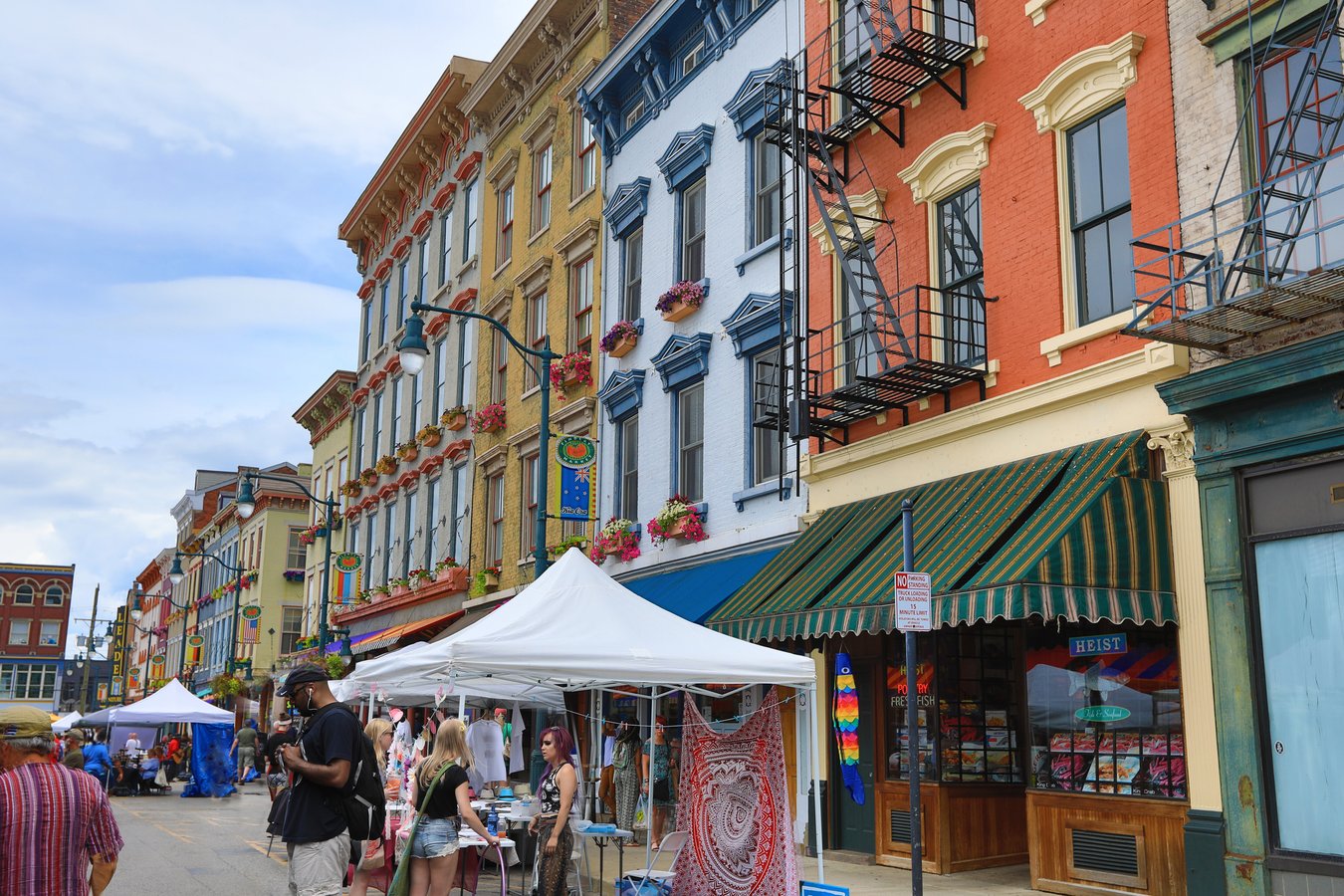
There is a familiar version of this story that shows up on bumper stickers and chalkboard signs: Shop local. Support small business. Buy from your neighbor.
Those are good reminders. As a locally owned, homegrown community bank, we love the sentiment. But they do not fully capture what really happens when you choose to spend money at a locally owned business in Greater Cincinnati. The economic dynamics behind that choice are more intricate — and more powerful — than most people realize.
This is Greater Cincinnati’s economy, viewed through the everyday decisions you make about where to spend and where to bank.
How Big Is Greater Cincinnati's Economy?
The Greater Cincinnati MSA spans Southwest Ohio, Northern Kentucky and parts of Southeast Indiana — and it is not a small market:
- Regional GDP reached approximately $198 billion in 2024, making Greater Cincinnati the largest regional economy in Ohio and the second largest connected to Kentucky (Cincinnati USA Regional Chamber, 2025 State of the Region Report)
- Approximately 1.16 million nonfarm workers are employed across 15 counties (U.S. Bureau of Labor Statistics)
That is a major economic engine — and the health of that engine depends significantly on where the people inside it choose to spend their money.
What Actually Happens When You Spend a Dollar Locally?
The concept economists use to explain this is called the local multiplier effect. The idea is straightforward even if the math behind it is complex.
When you spend money at a locally owned business, that business generally uses a portion of that revenue to pay local employees, buy supplies from local vendors, pay rent to a local landlord and make charitable contributions to local organizations. Each of those recipients then spends their share locally, and the cycle continues.
Research consistently shows that local independent businesses recirculate significantly more revenue back into the local economy than national chain stores — meaning a dollar spent locally does far more work for your community than the same dollar spent elsewhere.
Put simply: your $50 dinner at a locally owned restaurant in Covington or Montgomery does not stop at $50. It ripples.
Why Do Chain Stores and Online Giants Work Differently?
When you spend money at a national chain or large online retailer, that revenue tends to leave the region immediately:
- Corporate profits flow to headquarters in other states
- Shareholder returns go to investors across the country
- Supply chains often have no local connection at all
Local businesses keep that revenue working here.
What Does Local Spending Mean for Jobs?
Local businesses are more likely to hire locally, source supplies from local vendors and bank with local financial institutions. Each of those decisions creates or sustains a job somewhere in the community. When enough consumers make enough local spending decisions consistently, the aggregate effect on employment is significant.
The Cincinnati USA Regional Chamber's 2025 State of the Region Report highlights the strong connection between local economic activity and regional employment growth, noting that Greater Cincinnati ranks second among peer metros for regional exports per capita — a sign of a regional economy with real productive depth.
That depth is built and sustained by a combination of large employers and the dense network of small and mid-sized businesses that support and surround them. That network is most resilient when consumers and businesses at every level choose to keep spending local where they can.
How Does Buying Local Shape a Community's Character?
There is a dimension to this conversation that doesn't show up in economic models but is real, nonetheless.
The businesses that define the character of a neighborhood — the independent restaurant that has been on the same corner for 20 years, the locally owned hardware store that knows your name, the family-run HVAC company whose trucks you recognize — exist because enough people in the community kept choosing them over the alternatives.
A 2024 consumer survey by Faire found that when a local shop closes, nearly 75% of consumers report feeling sad, worried, guilty or angry — reflecting the strong personal ties people form with local businesses that become part of the fabric of their neighborhoods.
Greater Cincinnati and Northern Kentucky have a deep, long-standing culture of local business ownership. The Covington restaurant corridor, Newport's business district, the independent retailers growing alongside community development in Montgomery and Blue Ash, the family-owned businesses in Boone and Warren counties, and the local home builders active in Kenton and Grant counties all signal something important about these communities. These businesses operate and inspire other entrepreneurs because local residents consistently choose them.
Where Does Community Banking Fit In?
A locally owned bank operates by the same economic logic as any other locally owned business.
Deposits made at Heritage Bank are reinvested in the communities we serve — supporting local families, local homebuyers and local businesses across Cincinnati and Northern Kentucky.
A deposit at a national bank may be deployed in markets that have nothing to do with this region. A deposit at Heritage Bank is reinvested here — in the same community where it was earned.
The same principle that applies to where you where you purchase flowers or get your car repaired applies to where you bank. When you bank locally, you are not just choosing a service provider. You are choosing where your money works.
A Few Practical Ways to Put This into Practice
Understanding the local multiplier effect is useful. Doing something with it is better. A few simple habits that add up over time:
- When choosing between a local and national option for a regular purchase, consider the local option first — not out of obligation but out of awareness that the economic difference is real
- Seek out local service providers for home repair, lawn care, accounting and other recurring needs — these businesses tend to have higher local multipliers than retail because more of their revenue goes to local labor
- If you own a business, review your own vendor relationships — local suppliers and local banking relationships contribute to the same economic ecosystem that supports your own customer base
- Connect with one of Greater Cincinnati's regional chambers — including the Cincinnati Regional Chamber, the Northern Kentucky Chamber of Commerce, the Grant County Chamber, the Northern Cincinnati Chamber, the Montgomery Chamber, the Mason Deerfield Chamber and the West Chester-Liberty Chamber Alliance — for networking, advocacy and help finding local suppliers
Greater Cincinnati Is Worth the Investment
Greater Cincinnati's economy — with a regional GDP of approximately $198 billion according to the Cincinnati USA Regional Chamber's 2025 State of the Region Report — outpaces Midwestern peers across multiple measures. It is a region with genuine economic momentum, built and sustained by the everyday decisions of the people and businesses who live and work here.
Shopping local is one of those decisions. Banking local is another. Neither one alone changes everything. But collectively, consistently made across a community this size, they add up to something that matters.
Heritage Bank has been part of this community since 1990. We take deposits from Greater Cincinnati and put them back to work here — through mortgages, local business loans and the relationships we build with the people who are building something in this region. That is what community banking means to us. And it is why we believe the local multiplier effect is not just an economic theory. It is the reason this community stays strong.
This content is intended for general informational purposes only and does not constitute financial, legal or tax advice. Please consult a qualified professional before making financial decisions.