250 Years of Banking in Greater Cincinnati: From Flatboats to Fintech
This Fourth of July, the United States turns 250. And while most celebrations will center on fireworks, cookouts and parades, we think there is something worth pausing on: the remarkable financial history of the region we call home.
Cincinnati and Northern Kentucky have been at the center of American economic life since the country’s earliest days. The Ohio River made this region a gateway to westward expansion, and the financial institutions that grew along its banks helped finance the farms, factories, businesses and families that built the country we celebrate today.
Here is a look at 250 years of banking history in Greater Cincinnati — from the frontier settlements of the 1770s to the independent community bank that still serves this region today.
The 1770s–1800s: The Frontier and the First Settlements
Greater Cincinnati's story begins at the river. The first permanent settlement in present-day Cincinnati was established in 1788 at the mouth of the Little Miami River, when early entrepreneurs Israel Ludlow, Matthias Denman and Robert Patterson purchased 800 acres of land and established a settlement opposite the mouth of the Licking River.
Financial life on the frontier was informal and precarious. Currency was scarce, barter was common and the few coins in circulation were often foreign. Paper money of dubious value circulated widely, and the concept of a trusted local institution where a family could safely deposit their savings was still generations away from becoming a reality for most residents of the region.
But Cincinnati would not wait long. The first institution in Ohio to issue notes for circulation as money was the Miami Exporting Company of Cincinnati, incorporated on April 15, 1803, at the first session of the new Ohio General Assembly. Though its charter made no reference to banking, it issued notes that passed into circulation and by 1807 operated solely as a banking institution — continuing until 1842.
Across the river in Kentucky, the state's first banking institution, the Bank of Kentucky, was chartered by the Kentucky General Assembly in 1806. The first bank in Northern Kentucky itself was established in Washington, Mason County, in 1809, with General Harry Lee as its first president.
The 1810s–1850s: Cincinnati Becomes a Banking Center
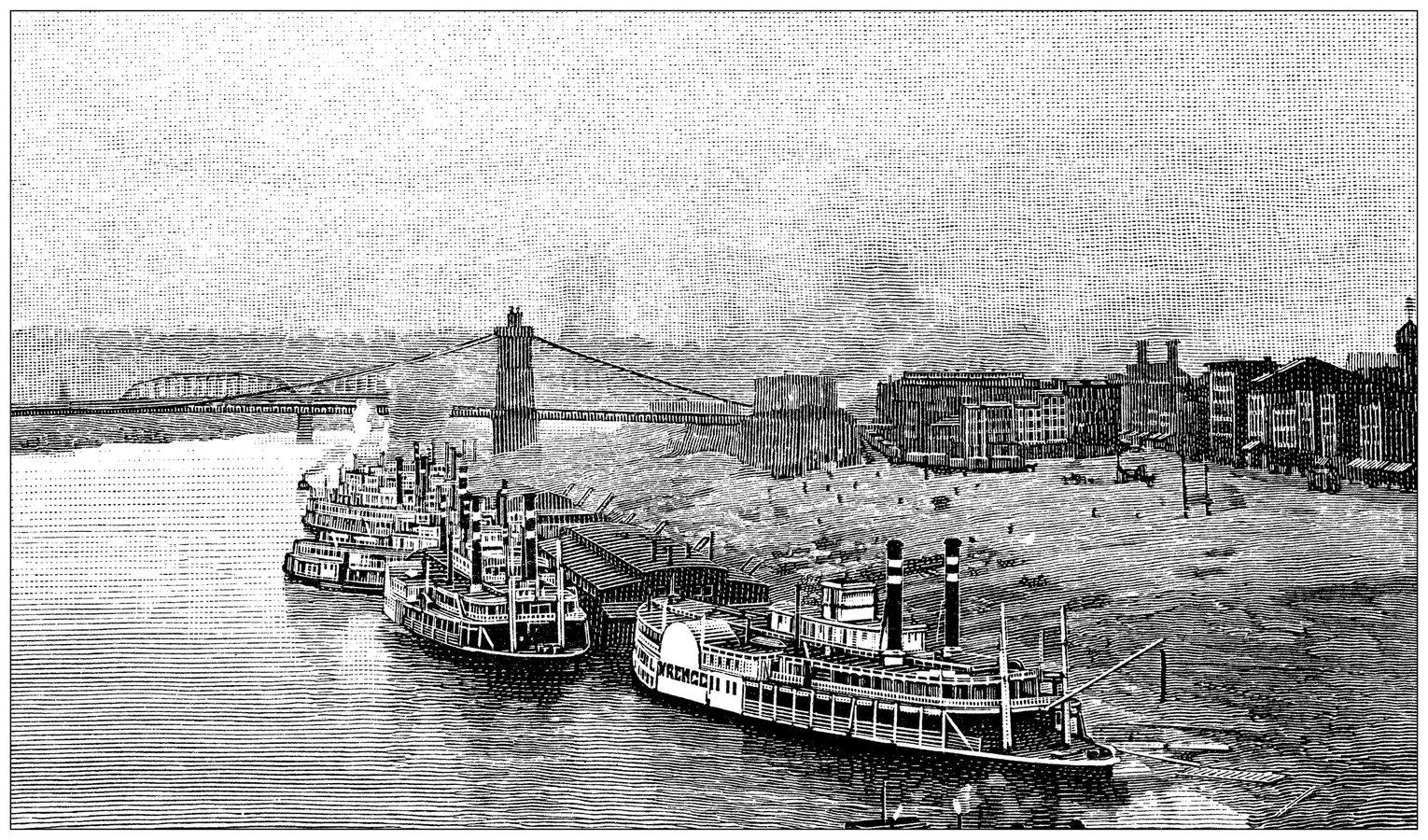
As the steamboat era transformed the Ohio River from a migration route into a commercial highway, Cincinnati grew rapidly into one of the most important cities in the young nation. By 1848 it ranked as the sixth largest city in the United States, with steamboat traffic peaking in 1852 when 8,000 landings were recorded at the city's waterfront.
Banking grew alongside commerce. By the 1810s Cincinnati had established multiple banking institutions, including the Farmers and Mechanics Bank, organized in 1812, and the Commercial Bank, incorporated in 1829. By 1836, the city's five banks represented a total capital of more than $4 million — making Cincinnati the state's dominant commercial and banking center. Those institutions financed the pork-packing trade that earned Cincinnati its nickname "Porkopolis," the river shipping industry and the wave of German and Irish immigrants who were reshaping the region's culture and economy.
Not all of this growth was stable. The Ohio Life Insurance and Trust Company, a major Cincinnati banking institution founded in 1830, collapsed in 1857 in what became known as the Panic of 1857 — one of the first truly national financial crises in American history. It was a stark reminder that even the most prominent financial institutions of the era operated without the depositor protections that Americans take for granted today.
The 1860s: The National Banking Act and Cincinnati’s First National Charters
The Civil War changed American banking forever. Rampant inflation during the war prompted passage of the National Banking Act of 1863, creating a uniform government-backed national currency to replace the diverse notes issued by state-chartered banks and private firms across the country.
Cincinnati was at the forefront of this transformation. In 1858, a group of visionaries led by William W. Scarborough founded the Bank of the Ohio Valley in Cincinnati — an institution that would eventually become part of the lineage that produced some of the most recognizable banking names in the country, a reminder that the roots of American banking run directly through the streets of Greater Cincinnati.
In 1863, a group of influential Cincinnati businessmen applied for and received one of the first national bank charters in the country. Their institution, Cincinnati's Third National Bank, opened that year under a 20-year charter.
Across the river in Northern Kentucky, businessman and philanthropist Amos Shinkle served as a founder and the first president of the First National Bank of Covington, which opened in January 1865. Shinkle was also the driving force behind the Roebling Suspension Bridge connecting Covington and Cincinnati, which opened in 1867 — cementing the economic relationship between the two sides of the river that defines Greater Cincinnati to this day.
The 1870s–1900s: Mergers, Growth and a Region Taking Shape
The late 19th century was characterized by consolidation, growth and the gradual professionalization of banking on both sides of the river. In April 1871, the Third National Bank acquired the Bank of the Ohio Valley. By 1888 another institution had taken the name Fifth National Bank, and on June 1, 1908, Third National Bank and Fifth National Bank merged to become the Fifth-Third National Bank of Cincinnati — with the hyphen later dropped.
The name itself tells the story: rather than erasing the identity of either predecessor, the founders combined them. Other significant names in local banking from this era include the First National Bank of Cincinnati — eventually becoming Star Bank, then Firstar and now part of U.S. Bancorp — along with First Financial Bancorp and Provident Bank, later absorbed into National City and now part of PNC.
By the early 1900s, Greater Cincinnati had developed one of the most sophisticated regional banking ecosystems in the Midwest — serving the German immigrant population, the commercial merchant class and the growing industrial workforce in a region that had matured from a frontier trading post into a major American city.
The 1920s–1930s: The Great Depression and the Birth of Depositor Protection
The prosperity of the 1920s masked serious vulnerabilities in the American banking system. When the Great Depression arrived in 1929, the consequences for banks — and their depositors — were devastating. According to the FDIC, during 1933 alone there were approximately 4,000 bank suspensions across the United States, with the number of operating commercial banks dropping to just over 14,000 — roughly half as many as in 1920.
In the Cincinnati area, stronger institutions absorbed failing ones between 1930 and 1933, a pattern playing out across the country as the banking system strained under the weight of the Depression.
The crisis produced one of the most consequential pieces of financial legislation in American history. The Glass-Steagall Act, signed by President Roosevelt in June 1933, separated commercial from investment banking and established the Federal Deposit Insurance Corporation — the FDIC. According to the FDIC, on its first day of operation, deposit insurance covered 12,551 commercial banks with total insured deposits of approximately $11 billion.
For everyday Americans — including families in Cincinnati and Northern Kentucky — the FDIC represented something genuinely new: the assurance that the money they deposited in a bank would be there when they needed it, regardless of what happened to the institution. That protection remains in place today and is one of the foundational reasons Americans trust their banks with their financial lives.
The Mid-20th Century: Suburban Growth and the Community Bank Era
The postwar decades brought dramatic change to Cincinnati and Northern Kentucky. The region expanded outward, new suburbs grew in Boone, Campbell and Kenton counties, and communities in northern and eastern Hamilton County became magnets for young families looking for a home to own and a place to raise children. The demand for mortgage lending, car loans and personal checking accounts grew alongside the population.
Community banks played a central role in financing that growth. Unlike larger institutions, community banks were embedded in specific neighborhoods and counties — making lending decisions based on local knowledge and personal relationships. The banker who approved your mortgage was also likely the parent at your child's school and the neighbor at your church.
This era also saw significant consolidation at the regional level. Larger institutions absorbed smaller ones, and the banking landscape of Greater Cincinnati began shifting from dozens of independent local banks toward a smaller number of larger regional players.
The 1980s–1990s: Consolidation, Deregulation and Why Heritage Bank Was Founded
The 1980s and early 1990s brought a wave of mergers and acquisitions that fundamentally reshaped American banking. Interstate banking deregulation allowed large banks to cross state lines and acquire local institutions at an accelerating pace. For many communities, familiar local banks with deep regional ties disappeared into national brands practically overnight.
It was precisely this environment that gave rise to Heritage Bank.
Heritage Bank was founded in 1990 by Arnold Caddell, one of Northern Kentucky's most respected entrepreneurs and philanthropists. He brought together a group of local businesspeople who shared his concern about shrinking access to community banking — and who asked a simple question: where would local families find bankers who knew them by name, and where would tomorrow's entrepreneurs and independent businesses find banks genuinely committed to their success?
Heritage Bank was formally established on September 4, 1990. Its founding philosophy was a direct response to the consolidation wave: that Cincinnati and Northern Kentucky deserved a bank that was genuinely rooted here, making decisions here and investing its deposits back into this community.
The 2000s–Present: Digital Banking, Economic Cycles and Staying Independent
The decades since Heritage Bank's founding have brought dramatic change to the industry. The 2008 financial crisis tested banks across the country — and reinforced the value of conservative, relationship-based community banking that avoided the speculative excesses that threatened larger institutions.
Online banking, mobile deposits and digital payments have transformed how customers interact with their money. At Heritage Bank, we have embraced that evolution — investing in the digital tools our customers expect while holding onto what has always set us apart: the ability to pick up the phone and reach a real person, walk into a branch and be recognized by name, and work with a banker who actually knows your story.
Through all of it, Heritage Bank's purpose has remained unchanged: to take deposits from this community, reinvest them here through loans and services and build relationships that last longer than any single transaction.
Today Heritage Bank operates 19 locations across Greater Cincinnati and Northern Kentucky and remains one of the region's leading resources for small to mid-sized business banking. The bank remains independently owned — a direct line back to the founding principle that this region deserves a bank that lives here.
250 Years On: What Banking in Cincinnati and Northern Kentucky Means Today
From the flatboats on the Ohio River in 1788 to the mobile banking apps in your pocket today, the history of banking in Greater Cincinnati is a history of this community itself — its growth, its resilience, its entrepreneurial spirit and its commitment to taking care of its neighbors.
The tools have changed dramatically. The purpose has not.
We are proud to be part of that story — and proud to serve the people and businesses of Greater Cincinnati and Northern Kentucky as a community bank that is genuinely, independently and permanently rooted here. When it comes to your finances, there is something to be said for banking with people who actually live here, know this region and are genuinely invested in seeing it thrive — not just a name on a building.
From all of us at Heritage Bank, Happy 250th Birthday, America.
This content is intended for general informational purposes only and does not constitute financial, legal or tax advice. Please consult a qualified professional before making financial decisions.